The first time a real prospect asks “so what does this cost?” most fractional CDOs freeze. You have maybe three seconds before the silence gets awkward, so you pick a number that feels safe. It’s almost always too low. Worse, that number becomes your anchor. Every future engagement gets quoted against the figure you blurted out on one call when you weren’t ready, and walking it back later feels impossible.
In This Article
Pricing feels like a confidence problem. It isn’t. It’s a math problem wearing a confidence problem’s clothes. Once you’ve done the arithmetic, the number stops being scary, because you can defend every part of it out loud. A prospect who pushes back gets an answer instead of a flinch. This article gives you the framework and a calculator you can run in thirty seconds. By the end you’ll have your floor rate written down, and a reason for it you’d be comfortable saying to a CFO.
What does a fractional CDO actually charge?
If you came here from a search box, you probably want the range first, so here it is.
A sustainable fractional CDO retainer sits between $10,000 and $20,000 per month per client, with $15,000 a healthy middle for someone with real operating experience. Top operators with a strong anchor client push past $20,000. On a per-day basis that works out to roughly $1,500 to $3,000, or $300 to $500 an hour if you insist on thinking in hours (you shouldn’t, more on that below). At two or three concurrent clients, a realistic year clears $350,000 to $450,000 gross.
Those are the market numbers, and they break down by engagement type. An advisory arrangement, where you’re a sounding board a few hours a week, lives at the bottom of the range. An embedded engagement, where you own the data roadmap and show up one or two days a week, sits in the middle. A time-boxed intensive, where you parachute in to fix a stalled migration or stand up reporting before a board meeting, commands the top because the urgency is the client’s, not yours.
All of that is useful for a sanity check and useless for setting your own rate. What others charge tells you nothing about what your income, your taxes, and your capacity require you to charge. That’s the calculation almost nobody runs, which is exactly why so many capable people leave money on the table for years.
Why most fractional CDOs underprice themselves
I’ve reviewed pricing for enough data leaders going independent to see the same mistakes repeat. Three of them do most of the damage.
They pick a number from the air. No math behind it, just a figure that sounds reasonable on a call. Reasonable usually means anchored to freelance and contractor rates the person has seen on Upwork or in a peer’s Slack, where a senior analyst might bill $90 an hour. So they quote $6,000 a month, feel bold for it, and have no idea they just signed up for a $130K year before tax. A fractional CDO is buying a seat at the strategy table, not selling hours of execution, but the number says otherwise and the client believes the number.
They anchor to their old salary. “I made $180K as a VP, so $15K a month feels about right.” This skips the part where a self-employed person pays their own payroll taxes, covers their own software and insurance, takes no paid vacation, and bills maybe 60% of their working hours. To net what a $180K salary nets, you have to gross two to three times your target take-home. A $180K salary equivalent is closer to a $360K to $400K gross practice, not a $180K one. Anchoring to the old salary number quietly guarantees you undercharge by half.
They sell hours instead of outcomes. The moment you agree to “20 hours a month at $5K,” you’ve handed the client a stopwatch. Month one always runs long because ramp-up is front-loaded: you’re learning the stack, meeting the team, and untangling whatever made them call you. Then scope creep does the rest, and by month three you’re working 35 hours for the price of 20 and resenting it. The retainer should buy a role and a set of outcomes, not a timesheet you’ll lose track of by week two.
If you’ve done at least one of these, you’re in good company. The fix is the same for all of them: stop starting from the market and start from your own numbers.
The 5 inputs you need to calculate your rate
Five things decide your floor. Get these honest and the rest is arithmetic.
- Target annual income, gross and pre-tax. What you want to make in your first year on your own. Pick the real number, the one that pays your mortgage and lets you sleep, not the aspirational one you’d put on a vision board. You can always raise it later when the pipeline supports it, and you will.
- Effective tax rate. Self-employment changes this more than people expect, because you’re now covering both halves of payroll tax on top of income tax. A US default around 35% is a fair starting point. In the UK and much of the EU it runs 30 to 45%. Use your actual bracket if you know it, and ask your accountant if you don’t.
- Operating expenses. Software, accounting, insurance, the occasional conference, the BI tool you keep for demos. For a solo practice this lands around $8,000 to $15,000 a year. It’s small relative to income, but it comes out before you pay yourself, so it belongs in the math.
- Billable utilization. The share of your working time you can actually bill. Sales calls, proposals, admin, and your own learning eat the rest, and they eat more than you think in year one. Somewhere between 55% and 65% is sustainable. If your rate only works at 85% utilization, you’ve built a plan with no time to find your next client.
- Available billable hours per month. About 140 for a solo practice, not the 160 you’d get from a naive 40-hour week. Holidays, sick days, and the unbillable overhead are already baked into that 140. Plan against the real number.
None of these is “what the market pays.” The market is a guardrail you check at the end, not the input you start from.
The formula, with a worked example
Here’s the whole thing:
Floor monthly rate per client =
   (Target income + Operating expenses)
   / (1 - Tax rate)
   / Number of clients
   / 12 months
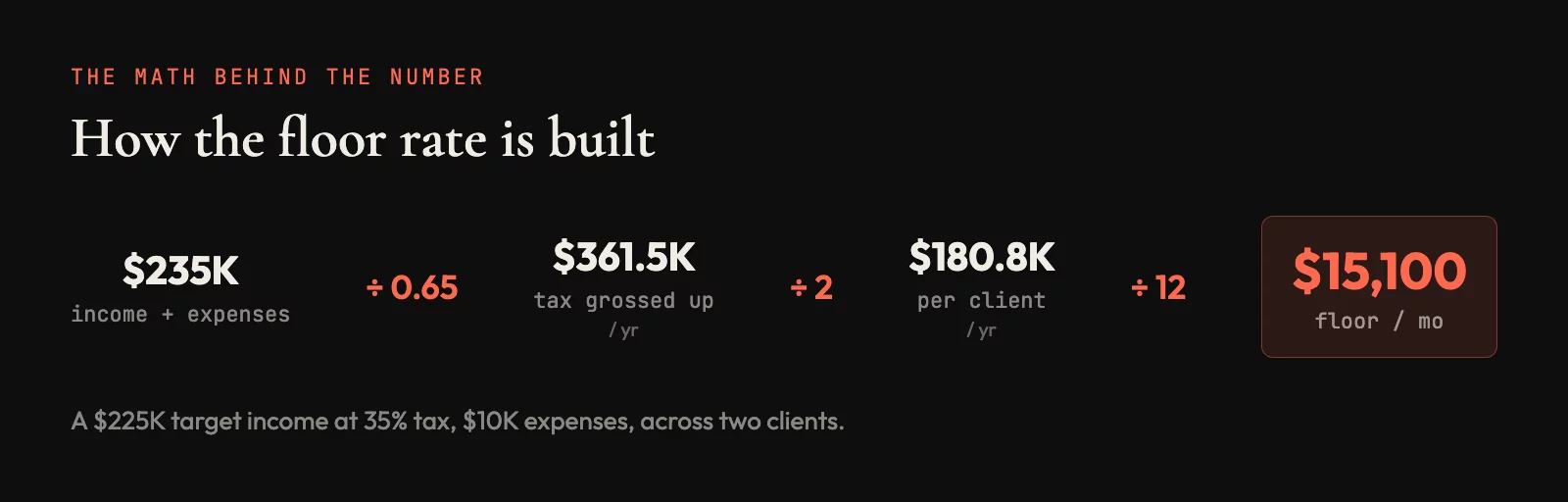
Run it once with real numbers. Say you want $225,000 gross, you’re taxed at 35%, you spend $10,000 a year to run the practice, and you plan to carry two clients.
($225,000 + $10,000) / (1 - 0.35) / 2 / 12
= $235,000 / 0.65 / 2 / 12
= $361,538 / 24
= about $15,100 per client per month
So your floor is about $15,100. Anything below that means you’re quietly accepting less than $225K, whether you realize it or not.
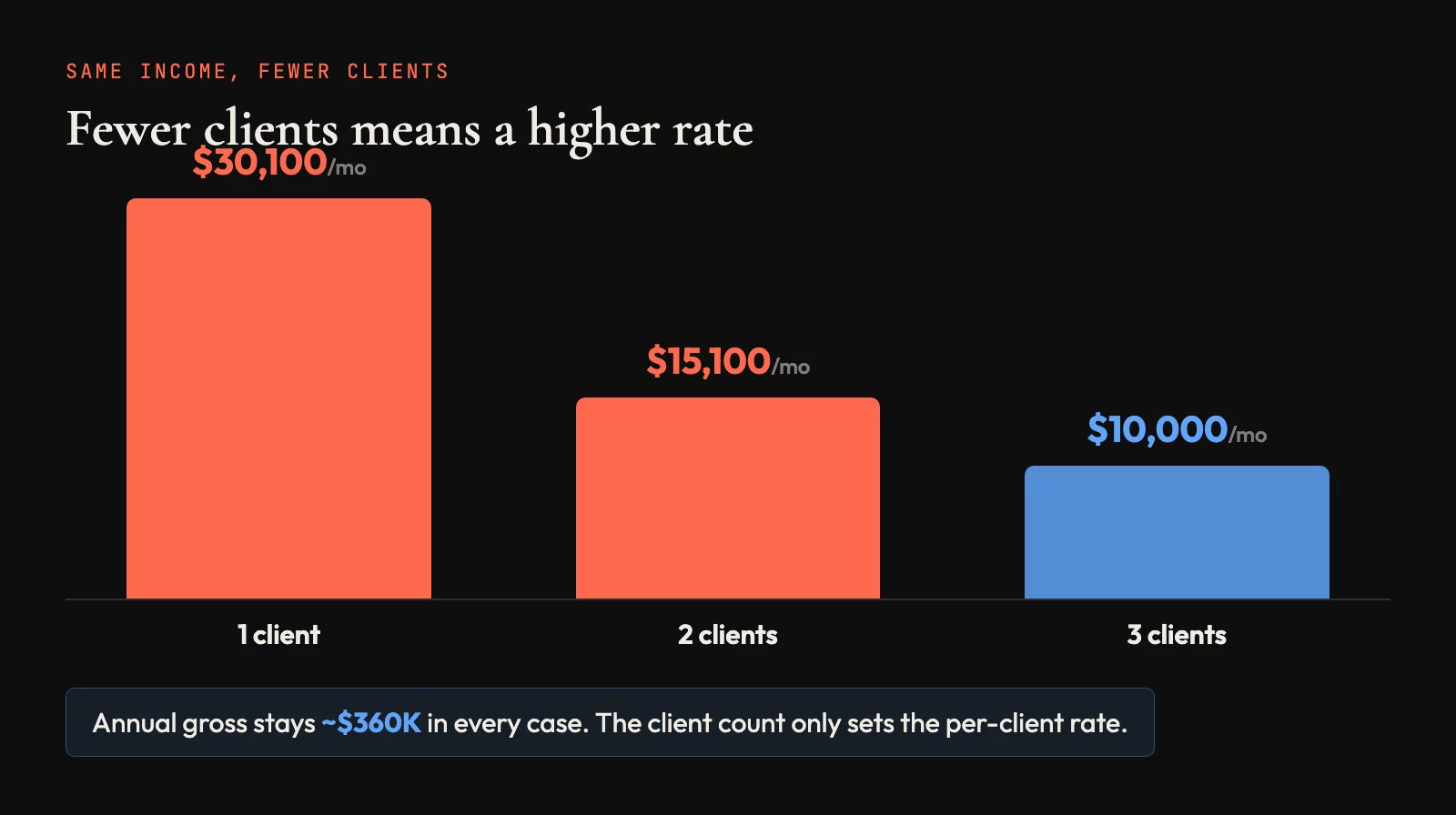
Here’s the part worth sitting with. Your total gross barely moves across all three cases, because it’s fixed by your income and tax rate, not by how you slice it. One client at $30K, two at $15K, or three at $10K all land near the same $360K a year. The client count doesn’t change how much you make. It changes how hard you work to make it, how many relationships you manage, and how exposed you are when one engagement ends. That’s the real argument for fewer clients at a higher rate: the same income with less delivery surface and more leverage in every pricing conversation.
The rate calculator
Plug in your own numbers. The floor rate updates as you move each input, so you can see immediately how a higher tax bracket or a fourth client changes the picture.
Get the full breakdown emailed to you
Your floor rate at one, two and three clients, plus the framework that turns it into a defendable offer.
No spam. Your results plus the Pricing & Packaging Kit framework.
The calculator gives you the floor. The Pricing & Packaging Kit covers what comes after the number: how to package the engagement into three tiers so the client chooses a level instead of negotiating the price, the one-page proposal that closes in hours rather than weeks, the scope-boundary language that defends the retainer against creep, and the raise cadence that moves your rate up with each new client instead of freezing it at whatever you charged the first one.
What your rate doesn’t tell you
A correct floor rate is necessary. It isn’t sufficient. You can know your number to the dollar and still lose the pricing conversation, usually for one of these reasons.
- You never packaged the offer. With no tiers to choose from, the client defaults to haggling the single number you put in front of them. Give them an advisory, an embedded, and an intensive option, and the conversation moves from “is this too expensive” to “which level is right for us.” You’ve changed the question they’re answering.
- Your proposal reads like a deck. Twelve slides of methodology trigger the procurement reflex, and procurement exists to push your price down. A one-page proposal that states the outcome, the structure, and the price reads like a decision a leader can make alone, and decisions made alone get made faster and at full price.
- You agreed to scope you can’t defend. Without a boundary written into the engagement, every “quick favor” chips away at the rate you calculated so carefully. The defense isn’t saying no, it’s having agreed in writing on what the retainer includes before the first favor gets asked.
- You stayed at your client-one rate for years. The first number you quote should be your lowest, because it’s the one you set with the least proof. Each new client is a chance to recalibrate upward, and most people never take it. They find their old rate in an email and copy it forward out of habit.
Each of these is its own discipline, and each one is where the money actually leaks after the math is right. The calculator fixes the input. These fix everything downstream of it. If you want the full system, that’s what the Data Leader Accelerator is built to teach, and you can read the longer argument in the fractional CDO guide.
When to raise your rate
The floor you calculate today is a year-one number. It should move. The cleanest trigger is the new-client moment: every time you add a client, quote them above your current rate, not at it. The new client has no anchor to your past pricing, so the only cost of asking for more is the half-second of nerve it takes. Do that consistently and your fourth client pays meaningfully more than your first, which is how a practice grows without adding hours.
The second trigger is proof. After a client renews, or refers you, or tells their board you were the best money they spent that year, your next quote should reflect it. Pricing is a story about value, and renewals are the evidence. Re-run the calculator each January with a higher target income and let the floor pull your quotes up with it.
FAQs
How much do fractional CDOs actually make per year? At two engagements averaging $15,000 a month, $360,000 a year is a realistic gross. With one anchor client at $20,000 plus a smaller second engagement, strong operators clear $400,000. Net depends on your taxes and expenses, which is exactly why the calculator works backward from the income you actually want to keep rather than forward from a rate.
What is a fractional CDO salary, and is it even the right question? There’s no salary, because a fractional CDO isn’t an employee. You earn retainers from multiple clients, not a single paycheck, and you carry your own taxes and benefits. The closest comparison is total practice revenue, which for an established fractional lands in the $300K to $450K range and isn’t capped the way a salary is.
What’s the difference between a fractional CDO and a consultant? A consultant sells projects with defined deliverables and bills against them. A fractional CDO sells ongoing ownership of the data function and bills a monthly retainer tied to the role. You’re not buying a report, you’re renting a head of data. The pricing reflects that, which is why per-project rates and fractional retainers don’t compare cleanly.
How do I price a fractional CDO engagement for a specific client? Start with your floor rate from the calculator, then adjust for the engagement type and the client’s stage. An embedded engagement at a Series B company with a messy stack sits above your floor. A light advisory retainer for a founder who mostly needs a second opinion sits near it. Never quote below the floor, because below the floor you’re funding the client’s data function out of your own income.
How many hours per week should a fractional CDO work per client? For an embedded engagement, one to two days a week per client is standard, roughly 25 to 35 hours a month. Advisory work runs lighter. A time-boxed crisis engagement runs heavier for a short window. The retainer covers the role, so resist the urge to itemize the hours on the invoice.
What’s the minimum engagement length? Three months for an embedded engagement, six for advisory. Anything shorter doesn’t give you the runway to actually influence strategy, and it signals to the client that this is a freelance gig rather than a leadership seat.
Can I start with just one client? Yes, and most successful fractional CDOs do. The math is on your side: one anchor client at $15,000 gets you to a $180,000-equivalent income faster than three clients at $9,000, with a fraction of the coordination overhead. Start with one, get the engagement right, then add the second from a position of proof.
Where to go from here
Your floor rate is a starting line, not a finish. The number tells you what you can’t go below. Turning that number into signed engagements at full price is the work the Pricing & Packaging Kit and the Accelerator are built for: the packaging, the proposal, the boundaries, and the raise cadence that took this same math into a $3M-plus practice.
Run your numbers above, write the floor down, and quote it next time without flinching.


