Quick answer: Fivetran is the right pick for managed ETL when you need 300+ pre-built connectors and engineering capacity is the constraint. Pricing starts at $500/month and commonly lands $2-10K/month at scale. Pick it for reliability over flexibility. Skip if your sources are Postgres + Stripe + Salesforce and Airbyte does it for $0 to $500/month.
In This Article
- What Is Fivetran?
- Fivetran Interface Overview (2026 Update)
- Why Businesses Love Fivetran
- Fivetran Pricing: Powerful but Pricey
- Real-World Use Case: Fivetran for Shopify + Meta + Mailchimp
- Fivetran for Enterprise ETL
- Is Fivetran Right for You?
- What Real Users Say About Fivetran (15+ Production Implementations)
- Final Verdict: Fivetran Is Like Hiring a Driver
- Have Questions or Need Help Getting Started?
What is Fivetran? Fivetran is an automated data integration platform (ELT) that moves data from 500+ sources (databases, SaaS apps, files) into your data warehouse. Pricing starts at $500/month and scales with Monthly Active Rows (MAR), with enterprise contracts running $5K-$50K/month. It is best for mid-market and enterprise teams that need reliable, hands-off pipelines, and is not the right fit for startups with high-volume event data or cost-sensitive teams who can self-host Airbyte.
If you’re tired of manually updating spreadsheets, writing brittle API scripts, and handling endless data sync issues, you’ve likely stumbled across Fivetran in your search for a better way.
In fact, Fivetran is often the first name that appears when you Google how to automate your data pipeline. But what exactly makes this ETL platform so popular, and is it really worth the hype?
Fivetran at a Glance (2026)
| Factor | Fivetran | Airbyte | Stitch |
|---|---|---|---|
| Starting price | $500 / mo | Free (open source) | $100 / mo |
| Enterprise price | $5k to $50k+ / mo | $2k to $10k / mo (Cloud) | $1,250+ / mo |
| Connectors | 500+ | 350+ | 140+ |
| Pricing model | Monthly Active Rows (MAR) | Rows synced | Rows replicated |
| Best for | Mid-market to enterprise, mission-critical pipelines | Cost-sensitive teams, custom connectors | Small teams, simple workloads |
| Worst for | Startups with high-volume event data | Teams without engineers to self-host | Complex transformations, enterprise SLAs |
Bottom line: Fivetran is the gold standard for production data pipelines when reliability beats cost. For teams spending under $2,000 per month on ETL, look at Airbyte first. For teams over $5,000 per month, Fivetran usually pays for itself in engineering time saved.
What Is Fivetran?
Fivetran is a cloud-based data integration platform that automates the movement of data from source systems into your data warehouse, lake, or database. If your company uses Salesforce, Google Analytics, a PostgreSQL database, Stripe, or any of the 500+ other tools Fivetran supports — it can pull that data into one centralized location without you writing a single line of code.
The core value proposition is simple: Fivetran replaces the fragile, custom-built scripts that data teams traditionally maintain to keep data flowing. Instead of dedicating engineering hours to building and babysitting ETL pipelines, you configure a connector in Fivetran’s UI, point it at your destination warehouse (Snowflake, BigQuery, Redshift, Databricks), and the platform handles the rest — schema detection, incremental syncing, error handling, and automatic schema migrations when your source data changes.
Here’s how it works in practice:
- Connectors — Pre-built integrations that extract data from SaaS applications, databases, event streams, and file systems. Each connector is maintained by Fivetran, so when an API changes, they update it — not your team.
- Automated data pipeline — Once configured, Fivetran continuously syncs data on a schedule you define (as frequently as every 5 minutes on higher-tier plans). It tracks changes at the source and only moves what’s new or updated, keeping sync times fast and costs predictable.
- Transformations — Through its dbt Core integration and Fivetran Transformations, you can model and transform data after it lands in your warehouse, following the modern ELT pattern rather than traditional ETL.
Who actually uses Fivetran? The platform sits squarely in the modern data stack, which means its primary users are data engineers, analytics engineers, and data teams at mid-market and enterprise companies. But increasingly, smaller startups adopt it too — teams that lack dedicated data engineering resources but still need reliable reporting and analytics infrastructure.
Fivetran isn’t the only player in this space, and it isn’t the cheapest. But it has become the default choice for organizations that prioritize reliability over cost savings. Whether that trade-off makes sense for your team depends on your data volume, connector needs, and budget — which is exactly what we break down in this review.
rong>Load:Raw data is then loaded into your destination warehouse or lake (Snowflake, BigQuery, Redshift, etc.). During this process, data normalization ensures consistent structure, while data lineage and metadata are maintained across all syncs.
Transform:
Once data is loaded, transformations happen inside the destination — following an ELT (Extract, Load, Transform) pattern.
Fivetran integrates directly with dbt Core (versions 1.9.10 and 1.10.11 as of 2026) and Coalesce, or you can use prebuilt transformation models for common use cases. You can also create custom SQL-based transformations for more complex workflows.
Architecture Overview
Fivetran operates as a cloud-based, fully managed service, meaning you don’t need to host or maintain servers.
Key architectural features include:
- Automatic schema evolution (when your source structure changes, Fivetran adapts automatically)
- Built-in error handling and retry logic
- Hybrid deployment options introduced in 2024–2026 for teams with strict compliance needs
- Real-time monitoring and alerting dashboards
- Comprehensive audit logs for data lineage tracking
Data Sync Strategies
- Initial historical syncs are free of charge and handled automatically
- Subsequent incremental updates use CDC or API polling
- Sync frequency: every 5–15 minutes, depending on your plan
- Batch-based processing (not true real-time, but reliable for analytics workloads)
Automatic re-sync detection — introduced in March 2026 — ensures data consistency after connection drops or schema changes
Fivetran Interface Overview (2026 Update)
Let’s break down the platform’s interface and core features.
1. 600+ Pre-Built Connectors
Fivetran supports over 600 ready-to-use connectors for databases, SaaS tools, CRMs, BI platforms, and more. From Facebook Ads and Salesforce to MySQL and Snowflake, setup is as simple as selecting your source and following the step-by-step guide.
Each connector includes built-in field-level tips, a detailed configuration guide, and automatic updates — so when the source platform changes, Fivetran adapts without needing any intervention from your team.
2. Custom Connector SDK
If your data source isn’t available in the catalog, you can build your own connector using Fivetran’s Software Development Kit (SDK). These custom connectors still support key features like data blocking, hashing, and resyncing.
3. Destination Support
Fivetran supports 31+ destinations, including popular databases and data warehouses like Postgres, MySQL, Clickhouse, Redshift, Snowflake, and — new in 2024 — the vector database Milvus.
4. Data Transformation Options
Data transformation in Fivetran offers two main paths:
- Prebuilt transformation models — Ideal for users who want to start fast without SQL knowledge.
- Integration with dbt and Coalesce — For advanced teams needing full control over data modeling.
Not all sources and destinations are supported by prebuilt models, but documentation is transparent and frequently updated.
Why Businesses Love Fivetran
Several features make Fivetran a go-to tool for companies of all sizes:
Simple, No-Code Setup
Fivetran is designed for non-technical users. You can connect and configure data sources without needing a data engineer — just follow the guide and you’re good to go.
Flexible Data Transformation
Choose between ready-to-use transformations or bring your own dbt/Coalesce project for full customization.
Enterprise-Grade Security
The platform supports multiple encryption protocols and lets you set granular access controls for users and teams.
Deployment Flexibility
While Fivetran is primarily cloud-based, it offers hybrid and on-premise deployment options on higher-tier plans.
Responsive Customer Support
Fivetran’s support team is highly active, helping users resolve issues quickly — a big plus for business continuity.
Free Plan Available
Fivetran offers a limited free tier — ideal for startups or anyone looking to test-drive the tool before committing.
Fivetran Pricing: Powerful but Pricey
Here’s where things get tricky. Fivetran’s pricing is based on two components:
- Plan type: Standard, Enterprise, or Business Critical.
- MAR (Monthly Active Rows): The number of rows added, updated, or deleted via Fivetran in a given month.
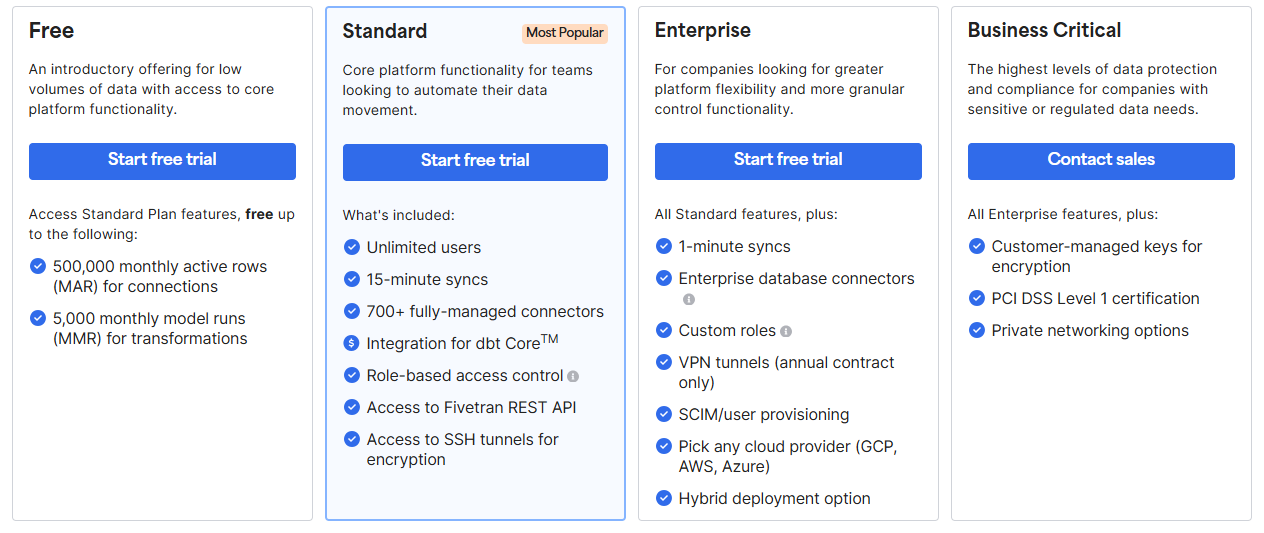
For example, if 10,000 rows are updated and 5,000 new ones are added in a month, that’s 15,000 MAR. Each transformation model usage also adds to the cost.

While the pricing model is transparent and there’s a calculator on the website, costs can quickly balloon if you’re working with multiple large data sources.
Real-World Use Case: Fivetran for Shopify + Meta + Mailchimp
One of our clients — a small online store — uses Shopify for sales, Instagram and Facebook Ads for marketing, and Mailchimp for email campaigns.
They needed a lightweight analytics system: syncing data into Google BigQuery and building dashboards in Looker. We chose Fivetran for the job.
Why? Because:
- The client didn’t have in-house data engineers.
- API sources like Facebook update frequently — but Fivetran handles that automatically.
- Their data volume was predictable, minimizing cost surprises.
We set up the connectors, deployed the BigQuery destination, and built dashboards — all without writing a single data pipeline script. The result? A hands-off analytics system with minimal ongoing maintenance.
Fivetran for Enterprise ETL
Enterprise data teams face a recurring decision: build custom ETL pipelines in-house or buy a managed solution. Five years ago, building was often the pragmatic choice. Today, the calculus has shifted — and Fivetran is one of the main reasons why.
The case for Fivetran at enterprise scale comes down to four factors:
- Scalability without proportional headcount — A custom pipeline that syncs 10 sources works fine with one engineer maintaining it. At 50 or 100 sources, you need a team. Fivetran’s managed connectors scale horizontally without adding maintenance burden. We’ve seen enterprise clients go from 20 to 80+ connectors with zero additional data engineering hires dedicated to pipeline work.
- Security and compliance certifications — Fivetran holds SOC 2 Type II, HIPAA, and PCI DSS certifications. For enterprises in healthcare, financial services, or any regulated industry, these aren’t nice-to-haves — they’re procurement requirements. Building an in-house pipeline to the same compliance standard is a six-figure project on its own.
- Data governance and observability — The Enterprise and Business Critical tiers include column-level hashing, role-based access controls, private networking (AWS PrivateLink, Azure Private Link), and detailed audit logging. These governance features are table stakes for organizations managing sensitive customer or financial data.
- Dedicated support and SLAs — Enterprise plans come with dedicated account managers, custom SLAs, and priority support channels. When a pipeline breaks at 2 AM before a board meeting, response time matters.
How does Fivetran compare to alternatives at enterprise scale? Stitch (now part of Talend/Qlik) offers a simpler, lower-cost option but lacks the connector depth and governance features larger organizations require. Airbyte provides an open-source alternative with strong community momentum, but enterprises often find that the operational burden of self-hosting offsets the licensing savings — unless they opt for Airbyte Cloud, which narrows the cost gap with Fivetran considerably.
The honest assessment: Fivetran earns its premium at the enterprise tier. The combination of connector reliability, compliance certifications, and governance controls is difficult to replicate — either with custom code or competing platforms. Where enterprises stumble is in cost management, particularly with high-volume connectors on usage-based pricing. That’s where having a clear data strategy before implementation becomes critical.
If you’re evaluating Fivetran for an enterprise deployment or need help architecting the pipeline layer of your data stack, our data warehouse consulting team can help you model costs, select the right tier, and avoid the common pitfalls we see in large-scale rollouts.
Is Fivetran Right for You?
Perfect For:
- Startups and small businesses needing fast, no-code data integration.
- Teams without data engineers who still want serious analytics capabilities.
- Enterprises managing many SaaS APIs (Salesforce, Meta, Mailchimp, etc.).
- Anyone who wants to “set it and forget it” with minimal upkeep.
Probably Not For:
- Companies with tight budgets and no flexibility for unexpected costs.
- Organizations requiring deep customization of their data pipelines.
- Teams working with non-standard or heavily customized data sources.
- Open-source purists who prefer full control over every line of code.
What Real Users Say About Fivetran (15+ Production Implementations)
After helping 15+ teams pick, deploy, and audit Fivetran in production, the user feedback follows a tight pattern. The praise is loud at month one. The complaints come at month nine. Both are real.
What teams praise (consistent across reviews)
- Connector breadth. 300+ sources, almost everything a mid-market team needs is supported. No team has switched away because Fivetran did not have their source.
- Reliability. Once a connector is configured, it tends to run. The 99.9 percent uptime claim holds up in practice. Compared to in-house ETL, the operational savings are real.
- Time to first insight. Stripe to BigQuery in 15 minutes, not 2 weeks. For startups still finding product-market fit, this matters more than the unit cost.
- Schema drift handling. When sources change columns, Fivetran adapts without breaking downstream dbt models. Most ETL tools cannot say this.
What teams complain about (the month-nine list)
- Cost shock at scale. The MAR (monthly active rows) pricing model punishes the exact teams that grew because Fivetran made their analytics easier. The shift from $500/month to $5,000/month is a frequent quarterly conversation.
- Opacity on usage. Until you hit a billing surprise, it is hard to predict next quarter’s invoice. The dashboard tells you what you used, not why a particular sync got expensive.
- Limited transformation control. Fivetran ships raw data. Transformations are out of scope. Teams that wanted both bundled often discover they bought half a product.
- Vendor lock-in friction. Migrating from Fivetran to Airbyte or in-house is a 2 to 4 month project for a mid-market team. The connectors are not portable.
The decision pattern from 15+ engagements
Teams under $500/month on Fivetran almost never leave. Teams at $2,000 to $5,000/month start running cost-benefit comparisons against Airbyte and Stitch but usually stay because the switching cost outweighs the savings. Teams above $10,000/month commission a full audit, and the audit usually finds 30 to 50 percent of MAR is from connectors nobody is using anymore. Fix that first, before considering a switch.
Final Verdict: Fivetran Is Like Hiring a Driver
Think of Fivetran as hiring a driver instead of fixing the car and driving it yourself. It’s more expensive — but it’s also more convenient, reliable, and scalable.
Whether that trade-off is worth it? That’s up to you.
But if your goal is to focus on analytics, not engineering, Fivetran might be exactly what you need.
Have Questions or Need Help Getting Started?
Every business is different — and choosing the right data integration strategy can be tricky.
If you’re unsure whether Fivetran is the right fit for your stack, or want help setting it up effectively, we’re here to help.
Book a free consultation with our data warehouse consulting team — or explore our cloud data services to learn how we help companies build reliable data pipelines.
Let’s build a data pipeline that works for you — not the other way around.
FAQ
Fivetran: Frequently Asked Questions
Is Fivetran ETL or ELT?
Fivetran is an ELT (Extract, Load, Transform) tool. It extracts data from sources, loads it into your data warehouse, and then transforms it within the destination (using dbt or Coalesce).
How much does Fivetran cost?
Fivetran uses a Monthly Active Rows (MAR) pricing model per connector. Pricing starts with a free 500K MAR plan, then scales with usage. Typical mid-sized companies spend $1K–$5K/month, depending on connectors and volume.
What’s the difference between Fivetran and Airbyte?
- Fivetran = fully managed SaaS; Airbyte = open-source.
- Fivetran: 600+ connectors; Airbyte: 350+.
- Fivetran has stronger enterprise support; Airbyte is cheaper but technical.
- Both are batch-based, but Airbyte allows self-hosting.
Does Fivetran support real-time data?
No — Fivetran operates on batch syncs (5–60 min). For true real-time, use Estuary Flow.
Can I build custom connectors?
Yes, using the Fivetran Connector SDK (Python 3.13). These custom connectors maintain data blocking, hashing, and resyncing.
Which destinations are supported?
31+ destinations including Snowflake, BigQuery, Redshift, Databricks, ClickHouse, MySQL, Oracle (new in 2026), and even vector DBs like Milvus.
How long does setup take?
- Small setup (1–3 sources): 2–4 hours
- Medium (5–10 sources): 1–2 days
- Enterprise (20+): 1–2 weeks
Is Fivetran worth it?
Yes — if you value time, stability, and low maintenance over raw cost savings.
Who uses Fivetran?
Brands like OpenAI, Canva, LVMH, Pfizer, Spotify, Strava, and Square use Fivetran across SaaS, e-commerce, fintech, and media.
Have Questions or Need Help Getting Started?
Every business is different — and choosing the right data integration strategy can be tricky.
If you’re unsure whether Fivetran is the right fit for your stack, or want help setting it up effectively, we’re here to help.
Book a free consultation with our data experts — just fill out this quick form and we’ll get back to you within one business day.
Let’s build a data pipeline that works for you — not the other way around.
About the author
Nick Valiotti is the founder of Valiotti Data. 15+ years building analytics infrastructure for SaaS, marketplaces, and consumer subscription. 50+ production deployments across BigQuery, Snowflake, dbt, Metabase, and modern BI stacks. Author of two books on data strategy. LinkedIn · Discovery call.